
What Are The Types Of Amplifiers
December 1, 2025
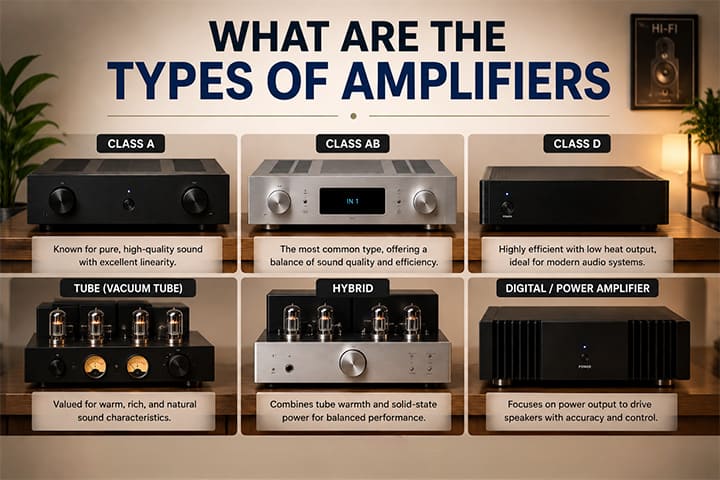
Amplifiers are one of the most important components in any high-fidelity audio system. Their role is not only to increase signal strength, but also to preserve the integrity, dynamics, tonal balance, and emotional realism of music. Different amplifier designs offer different strengths, sonic characteristics, and operating principles, which is why amplifier selection plays a major role in overall system synergy.
Understanding the different amplifier types helps audiophiles make more informed decisions based on their speakers, listening preferences, room size, and desired sound presentation.
Understanding Amplifier Roles
At the most basic level, amplifiers are designed to increase signal strength.
A voltage amplifier increases signal voltage and is commonly used in preamplifiers and phono stages. A current amplifier increases current delivery for difficult loads, while a power amplifier increases both voltage and current to properly drive loudspeakers. In most high-fidelity systems, the power amplifier is responsible for controlling speaker movement, dynamics, bass authority, and overall musical energy.
Audio Amplifier Classes
Amplifier “classes” describe how the output devices operate during the audio waveform cycle. Each class has its own balance of efficiency, heat generation, linearity, and sonic behavior.
Class A Amplifiers
Class A amplifiers conduct throughout the entire waveform cycle, resulting in exceptional linearity and extremely low crossover distortion. These designs are often associated with purity, smoothness, tonal richness, and natural harmonic texture.
Many high-end single-ended tube amplifiers and premium solid-state amplifiers operate in pure Class A. While highly regarded for musicality, they are inefficient, generate substantial heat, and typically produce lower power output.
Audiophiles often choose Class A designs for their fluid midrange, holographic imaging, and organic presentation.
Class AB Amplifiers
Class AB is the most common topology used in high-fidelity audio because it balances musical performance with efficiency. Output devices conduct slightly more than half the waveform cycle, greatly reducing crossover distortion compared to pure Class B operation.
Well-designed Class AB amplifiers offer excellent dynamics, strong bass control, high power capability, and low distortion while remaining practical for daily listening.
Many reference-level solid-state amplifiers use advanced Class AB designs due to their versatility and broad speaker compatibility.
Class B Amplifiers
Class B amplifiers are more efficient because each output device conducts only half the waveform cycle. However, this creates significant crossover distortion around the transition point between devices.
Pure Class B designs are rarely used in serious high-end audio applications due to their less refined sound quality.
Class D Amplifiers
Class D amplifiers use high-speed switching technology rather than continuously operating output devices. This results in extremely high efficiency, compact size, low heat generation, and impressive power output.
Modern high-end Class D amplifiers have improved dramatically in transparency, speed, bass control, and overall refinement. When properly engineered, they can rival or exceed traditional Class AB performance while offering significantly greater efficiency.
Class D amplification is especially popular for high-power systems, active speakers, subwoofers, and modern compact systems.
Single-Ended Triode (SET) tube amplifiers are especially prized for midrange realism and tonal beauty, although they usually offer lower power output and require highly efficient speakers.
Push-pull tube amplifiers provide higher power, improved bass control, and greater headroom while retaining much of the musical character associated with tubes.
Many audiophiles value tube amplification not because it measures perfectly, but because of the way it presents musical harmonics and texture.
Solid-State Amplifiers
Solid-state amplifiers use transistors or MOSFET devices and are known for reliability, speed, control, low noise, and wide bandwidth.
They are capable of delivering high current and excellent speaker control, making them ideal for difficult speaker loads and modern full-range systems.
Depending on design philosophy, solid-state amplifiers can sound highly neutral and analytical, or smooth and musical.
Hybrid Amplifiers
Hybrid amplifiers combine tube and solid-state technologies to achieve a balance between musical warmth and speaker control.
A common configuration uses a tube input stage for harmonic richness and a solid-state output stage for current delivery and bass authority.
This approach allows listeners to enjoy some of the tonal beauty of tubes without sacrificing power and stability.
Specialized Amplifier Types
Headphone Amplifiers
Headphone amplifiers are optimized for low-noise performance and proper current delivery into headphone loads. High-quality headphone amplifiers improve dynamics, imaging, detail retrieval, and overall realism.
Phono Preamplifiers
Phono stages are essential for vinyl playback. They provide RIAA equalization and extremely low-noise amplification for delicate cartridge signals.
The quality of a phono stage significantly affects tonal balance, resolution, dynamics, and background silence in analog playback systems.
What Audiophiles Evaluate in an Amplifier
When evaluating amplification, experienced listeners often focus on both objective performance and subjective musical presentation.
Important performance factors include:
- Linearity and distortion performance
- Noise floor and background silence
- Dynamic headroom
- Output impedance and damping factor
- Bass control and speaker authority
- Tonal balance and harmonic texture
- Soundstage depth and imaging precision
- Tiber Accuracy
- Power supply stability and transformer quality
- Thermal management and sustained performance
System matching is equally important. A powerful amplifier alone does not guarantee excellent sound. The relationship between amplifier, speaker load, source quality, room acoustics, and listener preference ultimately determines overall system performance.
Choosing the Right Amplifier
The ideal amplifier depends on the listener’s goals, speakers, room size, and musical priorities.
A listener seeking intimacy, tonal beauty, and vocal realism may prefer a low-power Class A SET tube amplifier. Someone prioritizing control, dynamics, and full-range speaker authority may prefer a high-current solid-state Class AB design. For efficiency and high power, a modern Class D amplifier may provide the best balance of performance and practicality.
The best amplifier is not necessarily the one with the highest specifications or price. It is the one that creates the strongest connection between the listener and the music.
In high-end audio, true performance comes from synergy, careful matching, and thoughtful listening rather than specifications alone.