
What Are The Types Of Speakers
December 2, 2025
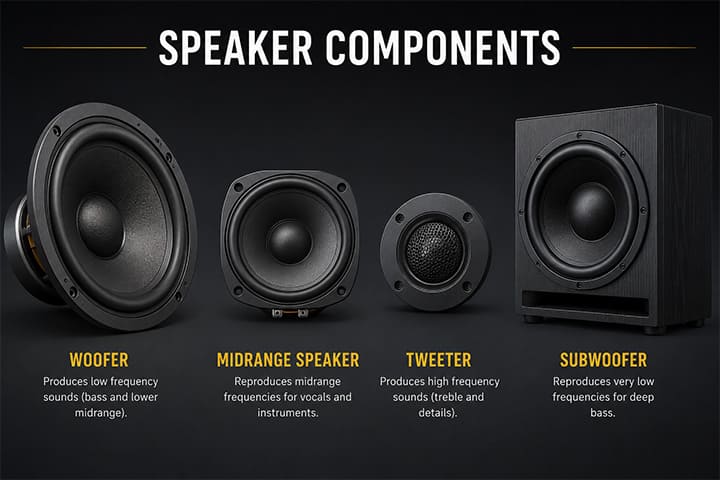
Speaker Components Audio, Frequency Range
- Woofer
- Reproduces low-frequency sounds (bass).
- Typically covers about 20 Hz–2 kHz.
- Midrange Speaker
- Handles middle frequencies, such as vocals and instruments.
- Tweeter
- Produces high-frequency sounds (treble).
- Covers roughly 2 kHz–20 kHz.
- Subwoofer
- Designed specifically for very deep bass frequencies.
By Installation Type
- Bookshelf Speakers
- Compact speakers placed on shelves or stands.
- Floor-Standing (Tower) Speakers
- Large speakers that stand on the floor and provide full-range sound.
- In-Wall Speakers
- Installed inside walls for a clean appearance.
- Ceiling Speakers
- Mounted in ceilings, often used in homes and offices.
By Connectivity
- Wired Speakers
- Connected using speaker cables.
- Wireless Speakers
- Use Bluetooth, Wi-Fi, or other wireless technologies.
- Smart Speakers
- Include voice assistants such as Amazon Echo or Google Nest Audio.
By Power Source
- Passive Speakers
- Require an external amplifier.
- Active (Powered) Speakers
- Have a built-in amplifier.
By Application
- Home Theater Speakers
- Computer Speakers
- Studio Monitor Speakers
- Portable Speakers
- Car Audio Speakers
- Public Address (PA) Speakers
The most common speaker setup for home audio is a combination of subwoofer + woofer/midrange + tweeter, which together reproduce the full range of audible sound.
In hi‑fi, “types of speakers” usually refers to two different dimensions:
- By physical form / placement (what you see in the room)
- By electronics / amplification (how they’re powered)
Both are important when choosing hi‑fi speakers.
1. By physical form and placementnottinghamhifi+2
Bookshelf (standmount) speakers
- Compact 2‑way speakers designed to sit on shelves, stands, or desks.
- Often used as main stereo speakers in small to medium rooms, or as front/surround speakers in home theater.
- Good balance of size and performance; many hi‑fi brands focus on these as entry‑level models.
Floorstanding (tower) speakers
- Tall speakers that sit directly on the floor, typically with larger cabinets and multiple drivers.
- Usually 2‑way or 3‑way, covering bass, mids, and treble with dedicated drivers.
- Better bass extension and volume capability; ideal for larger rooms and serious music listening.
Center channel speakers
- Designed mainly for home theater, placed below or above the TV.
- Handle most of the dialogue and front‑center sound.
- In strict 2‑channel hi‑fi music setups, a center channel is usually not used.
Surround / satellite speakers
- Smaller speakers placed to the sides or behind the listener for immersive surround sound.
- In hi‑fi, they’re mostly relevant for home theater or multi‑channel music (e.g., SACD, Dolby Atmos music).
- Pure 2‑channel hi‑fi typically uses just left and right main speakers.
In‑wall and in‑ceiling speakers
- Speakers built into the wall or ceiling for a discreet, “architectural” look.
- Can be hi‑fi quality, but often optimized for home theater or multi‑room music.
- Good if you want good sound without visible speaker boxes.
Subwoofers (in hi‑fi context)
- Dedicated bass speakers covering the lowest frequencies (typically 20–80 Hz).
- Used with main speakers to extend bass or offload it from the mains.
- In pure hi‑fi music systems, some people prefer full‑range mains without a sub; others use a sub for room‑filling bass.
Soundbars (less common in “pure” hi‑fi)
- Long, slim speakers for TV audio, sometimes with a separate wireless sub.
- Can be good value for movies, but most dedicated hi‑fi listeners prefer separate bookshelf or floorstanding speakers for music.
2. By amplification
Passive speakers
- No built‑in amplifier; they need an external hi‑fi amplifier or integrated amp.
- This is the traditional hi‑fi approach: separate amp + separate speakers.
- Allows more flexibility: you can upgrade amp or speakers independently.
Active (powered) speakers
- Have built‑in amplification and often active electronics (DSP, crossover, etc.).
- Connect directly to a source (DAC, streamer, preamp) via RCA, optical, HDMI, etc.
- Save space and simplify setup; popular for bedroom hi‑fi, desktop systems, and modern streaming setups.
How they relate
- You can have active bookshelf, active floorstanding, passive bookshelf, passive floorstanding, etc.
- So “type” can mean:
- “bookshelf vs floorstanding” (form)
- “active vs passive” (amplification)